
Plan
Define goals, constraints, layout, budget signals, and unknowns.
The ProcessProcess
Learn what we do, how we plan the work, what affects scope, and how our process helps homeowners understand key decisions before construction begins.
What we do
We help Gulf Coast homeowners improve the spaces they use every day, from full home transformations to focused kitchen, cabinetry, surface, lighting, and outdoor living upgrades.
A remodeling project is rarely just one decision. Cabinets affect countertops. Layout changes affect flooring, lighting, plumbing, electrical, permits, and schedule. Our job is to connect those decisions into one clear scope before construction begins.
Define goals, constraints, layout, budget signals, and unknowns.
Connect cabinets, surfaces, trades, permits, ordering, and schedule.
Build with communication, protection, quality control, and final review.
Use our remodeling planner to sort your project type, layout changes, cabinet scope, surfaces, trades, timeline, and readiness before we talk through the work.
Our specialties
Kitchen remodeling is the signature specialty, but real projects often connect to surrounding rooms, storage, surfaces, lighting, flooring, and outdoor living.
01
Complete interior transformations managed from planning through final finishes. We coordinate layouts, kitchens, bathrooms, flooring, structural updates, and finish selections so the entire home feels cohesive.
02
Kitchen design, space planning, material guidance, demolition, cabinetry, countertops, plumbing, electrical, flooring, backsplash, lighting, and final detailing.
03
Custom cabinetry, pantry systems, built-ins, pull-outs, organizers, soft-close systems, hardware, and finish selection planned around everyday use.
04
Quartz, granite, marble, quartzite, solid surfaces, backsplashes, sink and faucet integration, edge details, and finish upgrades with clean precision.
05
Tile, hardwood, laminate, luxury vinyl, recessed and pendant lighting, under-cabinet lighting, trim, painting, hardware, fixtures, and final detailing.
06
Outdoor kitchen layout, built-in grills, weather-resistant storage, countertops, sinks, refrigeration, plumbing, electrical, lighting, shade structures, and seating.
From plan to production
A remodel feels clearer when planning, readiness, and production are separated. Each phase has a purpose, and each phase protects the next one from rushed decisions.
We listen to your goals, review the space, document existing conditions, and define what needs to be included before pricing begins.
We organize the proposal, selections, agreement, ordering, and permit signals so the project can move forward with fewer unknowns.
Once the plan is ready, our team coordinates the work, communicates progress, checks quality, and walks the finished project with you.
How we work
A clean process gives homeowners a way to understand decisions, sequence, communication, and project expectations before construction begins.
01 / Consultation
We listen to your goals, evaluate the space, take measurements, and talk through design possibilities, budget comfort, timeline, and project fit.
The first visit is about understanding the home and the homeowner. You do not need final decisions before we meet. Photos, pain points, inspiration, rough budget range, and timeline goals are enough to begin.
The planner turns these process steps into a personal checklist of scope items, missing decisions, cost drivers, and questions to bring to the first conversation.
What customers need to know
Use the cabinet anatomy visual to connect proposal terms to real parts of the kitchen. The glossary explains what affects cost, durability, schedule, and finish quality.
The structural body of the cabinet that supports shelves, drawers, doors, and daily use. Box material and construction affect durability and alignment.
The front frame on framed cabinets that supports doors and drawer fronts and creates the visible cabinet openings.
A cabinet style without a front face frame. It often creates a cleaner modern look and slightly more interior access.
A lower cabinet that sits on the floor and supports countertops, sinks, appliances, drawers, and storage accessories.
An upper cabinet mounted to the wall above counters. Height, depth, and ceiling details affect storage and appearance.
A full-height cabinet often used for pantry storage, ovens, utility storage, or built-in appliance zones.
A finished side panel used where the side of a cabinet remains visible at the end of a run, island, or appliance opening.
A finished panel used on the back or sides of an island to make exposed cabinet areas look complete.
A connected line of cabinets along a wall or island. Runs affect appliance spacing, filler needs, countertop seams, and installation sequence.
The planned cabinet space for a refrigerator, oven, dishwasher, hood, or microwave. Accurate openings help avoid field changes and fit issues.
The visible cabinet door face that defines much of the style, color, material, and profile of the kitchen.
A door style with a recessed center panel and simple frame. Rail and stile width can change the overall look.
A flat, modern door or drawer face without a frame profile. It can make alignment and reveal spacing more noticeable.
The horizontal frame piece on a cabinet door, drawer front, or face frame.
The vertical frame piece on a cabinet door, drawer front, or face frame.
The visible face attached to the drawer box. It may match the door style or use a slab profile.
The interior drawer structure that carries everyday weight. Material, joinery, and depth affect durability and usability.
How much a door or drawer front covers the cabinet opening or face frame. Overlay affects reveal lines and style.
A door style where the door sits inside the cabinet frame opening instead of overlaying it.
The small visible gap or spacing between doors, drawers, frames, panels, and adjacent cabinet parts.
The hardware that controls drawer travel, weight capacity, extension, and soft-close feel.
A drawer slide that lets the drawer pull out far enough to access the full drawer depth.
Hardware that slows the final movement of a door or drawer so it closes quietly and with less impact.
Door hardware that affects alignment, opening angle, adjustment, and smooth movement.
A hidden hinge mounted inside the cabinet. It supports cleaner styling and allows adjustment after installation.
Handles or knobs selected for comfort, style, finish, and daily durability.
A pull mounted to a door or drawer front. Length, finish, placement, and comfort affect both style and daily use.
A small cabinet hardware piece usually mounted with one screw. Knobs can be simpler, but placement still matters for alignment.
The sink fixture selected for finish, height, spray function, clearance, and how it works with the sink and countertop cutouts.
Small supports that hold adjustable shelves inside a cabinet.
A base cabinet with stacked drawers instead of doors. It is useful for cookware, dishes, containers, and everyday storage.
A cabinet planned around organization needs such as pantry goods, cleaning supplies, appliances, trays, or utility items.
A sliding tray inside a cabinet that improves access to deep storage.
A shelf mounted on slides so stored items can be pulled forward instead of reached from the back.
A built-in accessory for utensils, spices, trash, trays, pans, pantry goods, or appliance storage.
A dedicated cabinet insert for trash and recycling bins. It affects cabinet width, hardware, and daily workflow.
A rotating corner storage accessory that improves access inside angled or blind corner cabinets.
A vertical divider used for sheet pans, cutting boards, trays, and tall flat items.
A cabinet feature that hides small appliances while keeping them accessible near the countertop.
The recessed base detail at the bottom of base cabinets that lets you stand comfortably closer to the counter.
The finished top detail that connects upper cabinets to the ceiling or gives the cabinet run a completed look.
A narrow trim piece used to close gaps and align cabinets cleanly with walls, appliances, or uneven conditions.
A thin trim used where cabinets meet uneven walls or ceilings so the finished edge looks clean.
Trim installed under upper cabinets, often used to conceal under-cabinet lighting.
Floor-level trim that may need to be removed, replaced, painted, or matched when cabinets, flooring, or walls change.
Small rounded trim often used at the floor or cabinet base to cover minor gaps between surfaces.
The shaped countertop perimeter detail. Edge style affects appearance, comfort, fabrication, and cost.
Granite, marble, quartzite, and other natural slabs. Each piece is unique and may vary in pattern, maintenance, cost, and availability.
An engineered surface made with mineral content and resin. Quartz is popular for durability, consistent design, and lower maintenance.
The pattern level in quartz slabs, from subtle movement to bold marble-like veining. Larger, more realistic patterns can affect cost and slab selection.
The shop process of cutting, edging, polishing, and preparing slabs for installation after template measurements are complete.
A planned opening in a countertop or surface for sinks, cooktops, faucets, soap dispensers, outlets, or accessories.
The wall finish above counters that protects the wall and completes the visual design.
A backsplash made from the same or similar slab material as the countertop. It can create a seamless premium look.
A countertop slab that continues vertically down the side of an island or cabinet end.
The countertop opening prepared for an undermount sink. Sink choice, reveal, and faucet holes affect fabrication.
The measuring process after cabinets are installed so countertop fabricators can produce the final slab pieces accurately.
A cabinet panel used to disguise an appliance, such as a refrigerator or dishwasher, so it blends with the cabinetry.
Lighting installed below wall cabinets to illuminate counters. It affects electrical planning, trim details, and final usability.
A finished cabinet panel used on exposed ends, islands, or appliance areas to create a more complete furniture-like look.
A cabinet door with a glass insert. Glass choices, lighting, and interior finish affect how display cabinets look.
The material between tile joints. Grout color, width, sealing, and maintenance affect the final backsplash or floor appearance.
Finish painting for walls, trim, or related areas disturbed by the remodel. It should be included clearly when needed.
Flexible sealant used at seams, corners, counters, backsplash edges, trim, and finish transitions for a cleaner final detail.
A visible cabinet side that receives a finished panel or matching surface so the cabinet run looks complete.
A finished material applied to the recessed toe-kick area for a cleaner final look.
The final list of small corrections, adjustments, touch-ups, and details to complete before handover.
The signed agreement that should define scope, payment terms, schedule assumptions, responsibilities, and how changes are handled.
A budget placeholder for a material or product not fully selected yet. Allowances should be clear so pricing expectations stay realistic.
A documented change to the agreed scope, price, or schedule before extra or different work proceeds.
The written description of what is included, what is excluded, and what assumptions the proposal is based on.
Potential hidden conditions discovered after opening walls, floors, ceilings, plumbing, electrical, or structural areas. Ask how unknowns are handled before work begins.
The initial payment collected before work begins or materials are ordered. The amount and timing should be clearly written in the agreement.
A payment request tied to a project milestone, material order, or completed phase of work.
A clearly stated item that is not included in the proposal. Exclusions help prevent misunderstanding later.
The time needed to order, fabricate, deliver, or schedule materials and trades before installation can happen.
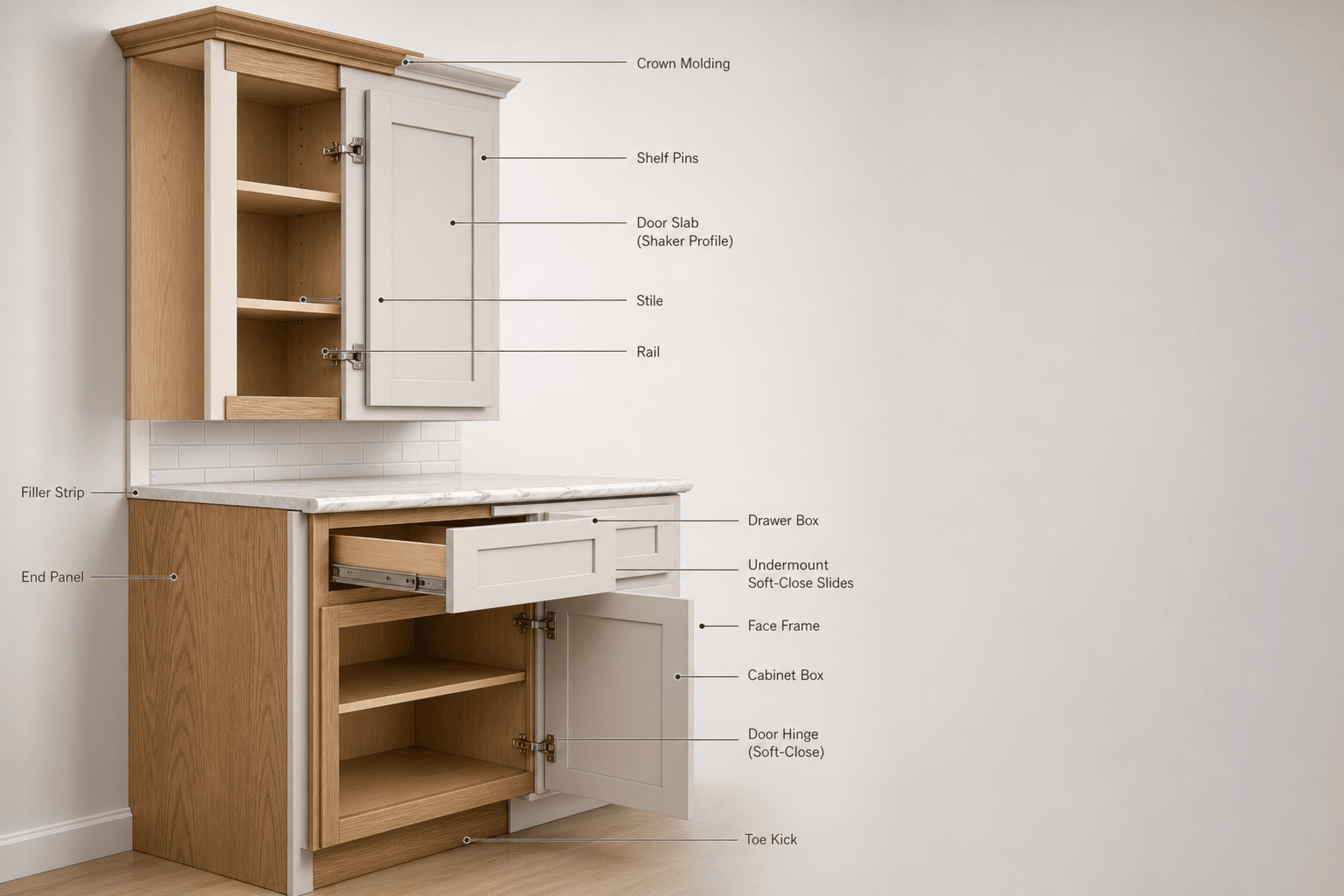
Cabinet anatomy glossary
Cabinet boxes, frames, drawer slides, toe kicks, fillers, panels, hinges, storage features, surfaces, and proposal terms all affect cost, durability, installation time, and final quality.
The structural body of the cabinet that supports shelves, drawers, doors, and daily use. Box material and construction affect durability and alignment.
Before we estimate
Small decisions can change the real scope of a kitchen remodel. Review these common cost and schedule drivers before comparing proposals.
Scope driver
Cabinet construction, drawer hardware, countertop material, lighting, backsplash, and layout changes all influence cost and schedule. We identify these details before estimating because the same kitchen can become a very different project depending on how much stays in place and how much changes.
Answer a few guided questions and the planner will summarize likely trades, cost drivers, permit signals, and decisions that still need attention.
Questions & Answers
Clear answers help homeowners make better decisions before construction starts. Use this section to understand our process, pricing approach, design planning, permits, execution, and the terminology you may hear during a kitchen remodeling consultation.
Getting Started
The first step is scheduling a consultation with our team. During the visit we discuss your goals, evaluate your space, take measurements, and talk through design possibilities. From there we develop a detailed scope of work and a fixed-price proposal based on your selections and project complexity.
Most kitchen remodels take 6-8 weeks of construction once permits and materials are ready. The planning phase, including consultation, proposal preparation, design work, and permitting, typically takes 2-4 weeks depending on the project scope. After we agree on the scope and budget and sign the agreement, we begin permit application if necessary. Depending on project complexity and jurisdiction, approval can take anywhere from a couple days to a few weeks. Once we have permit approval, it is easier to estimate the final construction timeline.
Not necessarily. Many homeowners come with ideas but not full plans. Depending on the complexity of your project, our team helps guide the design process and develop a layout that balances function, aesthetics, and budget before construction begins. Clarity before construction prevents stress during construction.
Yes. We help develop the layout, cabinet configuration, and material selections as part of the project development process. Depending on the complexity of your renovation, we may offer basic design layouts based on existing conditions or fuller design services for more complex projects. Full design preparation typically begins once a project agreement and deposit are in place.
It is helpful to think about: - What you dislike about your current kitchen - How you want the space to function - Design inspiration or styles you like - Your expected timeline You do not need final decisions. Our job is to guide you through that process.
Budget & Pricing
Most of our kitchen projects fall between $40,000 and $80,000, depending on cabinet quality and customization, countertop materials, layout changes, electrical and plumbing modifications, flooring integration, and appliance upgrades. Each project receives a fixed-price proposal based on detailed scope and selections.
The biggest cost drivers are cabinetry, structural layout changes, countertops and finishes, and electrical and plumbing complexity. Small cosmetic updates may cost significantly less than projects involving structural changes or custom cabinetry. Depending on the size of your kitchen and additional required work, your estimate can vary significantly. True numbers start to shape after the initial consultation and a clear understanding of scope and complexity.
We provide fixed pricing based on the agreed scope of work and selections. If the scope changes during the project, we document those changes through clear change orders before proceeding. Our goal is to create clarity before construction to avoid chaos during construction. For more complex remodeling, we may discuss a cost-plus pricing strategy, but most homeowners prefer predictability, and agreeing on detailed scope and budget upfront helps create predictability for both parties.
Yes. Most projects follow a milestone payment structure, often including a deposit, project-start payment, midway milestone, and final completion payment. The exact structure can be negotiated, but it is important that both parties feel comfortable with the process, timeline, budget, and terms before work begins.
Design & Planning
Yes. Many clients enjoy selecting finishes like backsplash tile, hardware, and fixtures. In those cases we may include allowances in the proposal to keep budgeting clear and flexible. We also provide a variety of supplier options so you can choose materials that achieve the best result for your goals.
Absolutely. Many homeowners want to improve flow, storage, or lighting. We help evaluate layout options and determine what structural or mechanical changes may be required. Once we understand your objectives and budget, we help achieve the best functionality, aesthetic, and quality within those objectives. Our goal is to maximize the return on your investment.
Often yes, but it depends on structural conditions. If a wall is load-bearing, structural support such as beams may be required. We evaluate these conditions during project planning. If structural, mechanical, electrical, or plumbing revisions are needed, we create a comprehensive plan and work with local jurisdictions to complete the work efficiently and in compliance with codes and regulations.
The most impactful decisions typically include cabinet construction and style, countertop material, layout and island design, lighting configuration, and appliance placement. Smaller finish choices matter visually, but they usually have less impact on the overall budget than layout, cabinets, surfaces, and trade work.
Cabinet selection depends on your desired style, budget, and level of customization. Options generally include stock, semi-custom, and fully custom cabinetry. We guide homeowners through these options based on their goals. We work with a variety of quality cabinet suppliers, and even our stock selections are generally well built. More custom material choices can affect timelines and budgets, but we help select the best fit for your goals.
Project Execution
Some projects require permits, especially when electrical, plumbing, or structural changes are involved. Our team prepares and submits the required documents when permits are needed. If we are doing only a like-for-like kitchen swap without electrical, plumbing, or structural modifications, some jurisdictions may not require permits. Depending on your location and local requirements, we guide you through what is required.
After the project agreement, we prepare design and permit documents and submit them to the local jurisdiction. Approval timelines vary depending on the municipality, scope, review requirements, and whether revisions are requested.
Some neighborhoods require HOA approval before work begins. We help coordinate the documentation required to obtain these approvals when necessary.
During most kitchen remodels the kitchen becomes temporarily unusable. Many homeowners set up a temporary kitchen space elsewhere in the home during construction. There are different phases of kitchen renovation, and most of the time the kitchen is not functional for regular use. Many finish pieces are installed at the very end, so we recommend customers plan for that.
We take steps to protect surrounding spaces by isolating work areas, maintaining clean job sites, and removing debris regularly. During demolition and dusty work, we cover registers and air intakes to help prevent dust circulation around other parts of the house. Usually, we arrange with homeowners to clear the space before work begins to minimize working around personal belongings, and we take care to keep the construction phase as neat as possible.
We use JobTread project management software, which allows clients to track progress, documents, invoices, and project updates in one place. Depending on how involved clients want to be, we can provide pictures, progress reports, and basic communication to make sure we stay on track and make timely changes if necessary.
If a change to the scope is requested, we issue a clear change order outlining cost and schedule adjustments before proceeding. Our goal is to create clarity before construction and avoid complex changes during construction. Change orders can affect timeline and budget, so we communicate as much detail as possible before construction. If a change is needed, we do our best to implement it efficiently.
Yes. We provide estimated timelines before construction begins. Timelines depend on permitting, material availability, and project complexity. We discuss timelines before the execution phase to create clear expectations on both ends.
Finishing & Post-Project
Our company combines deep construction knowledge with structured project management. Our founders bring experience from real estate, building department oversight, home inspection, and hands-on construction. This combination allows us to guide homeowners through remodeling with clarity, transparency, and reliable execution.
We focus heavily on clear scope definition before construction begins. This reduces surprises and helps projects run smoothly from start to finish. We offer a variety of options, from simple cabinet swaps to more complex custom kitchen designs, depending on your budget and timeline goals. We are flexible, professional, and transparent. We build trust one client at a time. Our reputation and reviews go before us, and we value what clients think of the process, not just the end result.
We guide the entire process, but homeowners remain involved in key decisions such as design selections and final approvals. Our goal is to create as much clarity as possible at the beginning of the project so homeowners can relax and enjoy the process as we execute the work. We keep you informed and confident throughout the project.
While kitchen remodeling is a major focus, we also complete other interior renovation projects depending on scope. We are a general contractor with a team able to run full-scale construction, additions, bathroom renovations, exterior work, and restoration remodels from damage to final finishes. Kitchen projects often involve a wider spectrum of work, and we guide homeowners through the entire renovation of their home.
We serve homeowners in Sarasota, Lakewood Ranch, Venice, Nokomis, Osprey, North Port, Port Charlotte, Englewood, Punta Gorda, Bradenton, Palmetto, Cape Coral, and nearby Southwest Florida communities, depending on project scope, schedule, and logistics.
You can schedule a consultation by contacting us through our website or calling our office. We will arrange a time to visit your home, discuss your project, and help you explore the best options for your kitchen transformation.
Free consultation
Tell us what you want to change, where the project is, and when you hope to begin. We will help you clarify scope, timing, budget signals, and the best next step before construction decisions start moving.
Start with a free consultation, or call iHome Built directly if you are still organizing details.
What happens next